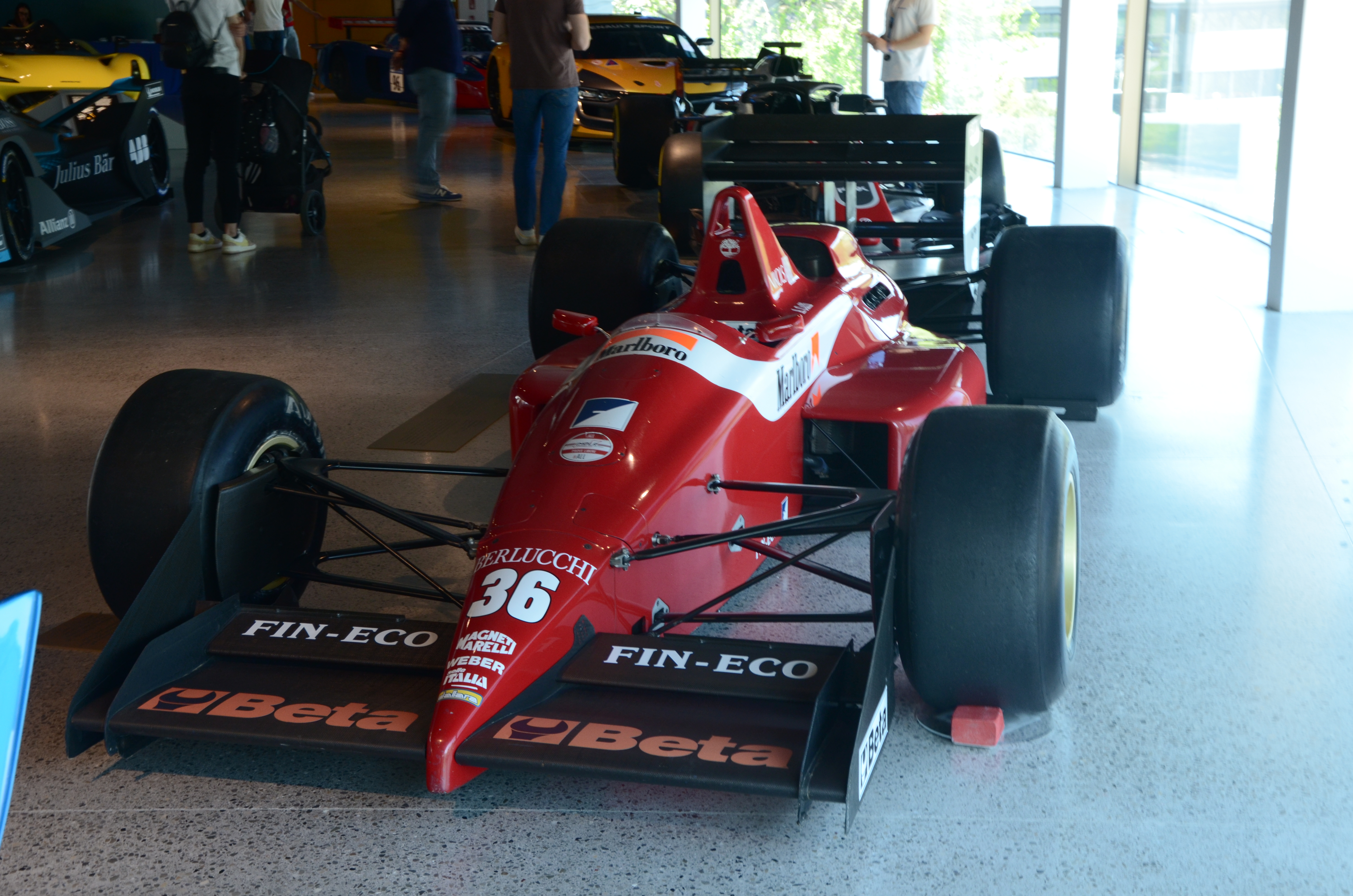
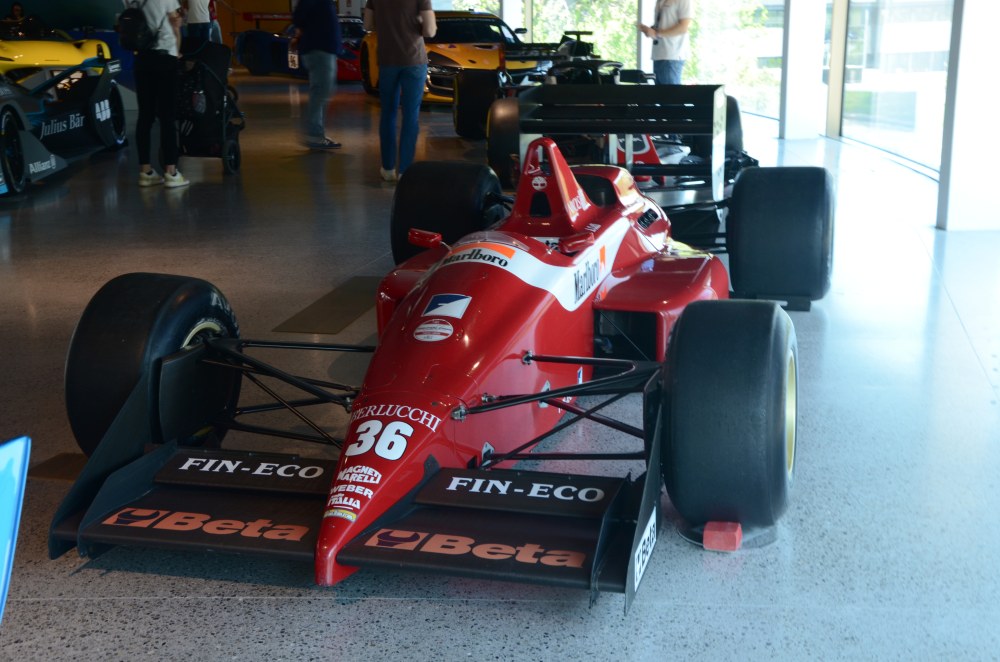
The Dallara F188 was the first purpose-built Formula One car produced by Dallara. It was designed for BMS Scuderia Italia for the 1988 Formula One World Championship, with Sergio Rinland as chief designer and Gian Paolo Dallara as technical director. The car used a naturally aspirated 3.5-litre Ford-Cosworth DFZ V8, a six-speed gearbox and Goodyear tyres.
One of the most distinctive features of the F188 was its unusually long 2,880 mm wheelbase, the longest of any Formula One car on the 1988 grid. The choice was partly practical: the customer Ford V8 required long radiators, and Sergio Rinland chose a long-wheelbase layout to accommodate them. Like much of the F188, it was a pragmatic solution for a new team working with limited resources.
The F188 was also an interesting car from an aerodynamic point of view. It is the earliest Formula One car known to RCR to incorporate the basic concept of a raised nose, creating a cleaner path for airflow underneath the front of the car. The idea was subtle on the F188 compared with the much more obvious solution introduced on the Tyrrell 019 in 1990, but the basic principle was already there.
Another innovation was its double-endplate front wing. According to Rinland, the F188 was the first car to use this arrangement, which was developed in Dallara's quarter-scale wind tunnel. It is an interesting detail on a car which is often remembered mainly as the first Formula One effort of a small new team rather than for the ideas incorporated into its design.
The F188 was intended to make its debut at the opening round of the 1988 season in Brazil, but it was not ready in time. This presented Scuderia Italia with a problem: under the Concorde Agreement the team was required to appear at every Grand Prix and could face a significant fine for failing to do so. The solution was wonderfully simple — bring a Formula 3000 car instead.
Scuderia Italia therefore arrived in Brazil with the Dallara 3087, a car originally built for the 1987 International Formula 3000 season. It was modified sufficiently to pass Formula One scrutineering but retained its 3.0-litre Ford-Cosworth DFV rather than the 3.5-litre engine permitted for naturally aspirated Formula One cars. Alex Caffi later described the trip essentially as an exercise in avoiding the fine: the team knew it had virtually no chance of qualifying, but it had appeared and fulfilled its obligation. Caffi duly failed to pre-qualify.
The actual F188 was ready for the next round at Imola, where Caffi qualified 24th and gave Dallara's first purpose-built Formula One car its first Grand Prix start. From there the car gradually became more competitive. Despite being operated as a single-car entry by a new Formula One team and competing against much better funded opposition — including the remaining turbo cars — Caffi qualified the F188 for all but one of the races in which it was entered.
Its best qualifying result came at the Hungarian Grand Prix, where Caffi qualified 10th. The best race result was 7th at the Portuguese Grand Prix, just one position short of a World Championship point under the scoring system used at the time. By the final race of the season in Adelaide, Caffi qualified 11th, showing how far the project had progressed during its first year.
The F188 scored no championship points, but the results alone probably undersell the car. Dallara and Scuderia Italia had started the year without even having their Formula One car ready, turned up in Brazil with an old F3000 machine simply to make sure they turned up at all, and ended the season capable of qualifying around the middle of the Formula One grid.
As far as RCR is currently aware, three F188 chassis were built. We have not yet been able to confirm this number directly with Dallara, so this may be updated if new information becomes available.
For 1989 the F188 was replaced by the Dallara F189, continuing a relationship between Dallara and Scuderia Italia which would last through the 1992 season.
The F188 may have scored zero points, but it was hardly an insignificant Formula One car. Its long-wheelbase layout, early raised-nose concept and pioneering double-endplate front wing make it an interesting piece of the aerodynamic development of late-1980s Formula One — and the beginning of Dallara's first sustained period as a Formula One constructor.