Team / entrant
Scuderia Italia
Team names, logos and trademarks remain the property of their respective
owners. Their display is for identification, documentation and historical
reference only and does not imply endorsement or affiliation with
Race Car Registry.
Profile
About this team / entrant
BMS Scuderia Italia is an Italian motor racing team founded by businessman and motorsport enthusiast Giuseppe Lucchini in Brescia, Italy. Its roots date back to 1983, when Lucchini established Brixia Motor Sport (BMS). The team initially competed in touring car racing before expanding its activities and eventually making the ambitious step into Formula 1.
Scuderia Italia entered the Formula 1 World Championship in 1988. Rather than establishing a complete design and manufacturing department of its own, the team adopted an unusual but effective model: Scuderia Italia operated the racing team, while specialist manufacturers were contracted to design and build its cars. For its first five Formula 1 seasons, this role was entrusted to Dallara.
The partnership began in 1988 with the Dallara F188. Because the project was completed too late for the opening Brazilian Grand Prix, Scuderia Italia initially appeared with a modified Formula 3000 car before the purpose-built F188 made its debut. Over the following seasons, Dallara developed a succession of Formula 1 cars for the team, culminating in the Ferrari-powered F192 of 1992.
Scuderia Italia achieved its best Formula 1 results during its partnership with Dallara. Andrea de Cesaris finished third at the 1989 Canadian Grand Prix, giving the team its first podium, while JJ Lehto scored another third place at the 1991 San Marino Grand Prix. The team became a familiar part of the Formula 1 midfield during this period, competing with considerably larger and better-funded organisations while retaining the relatively compact structure of an independent entrant.
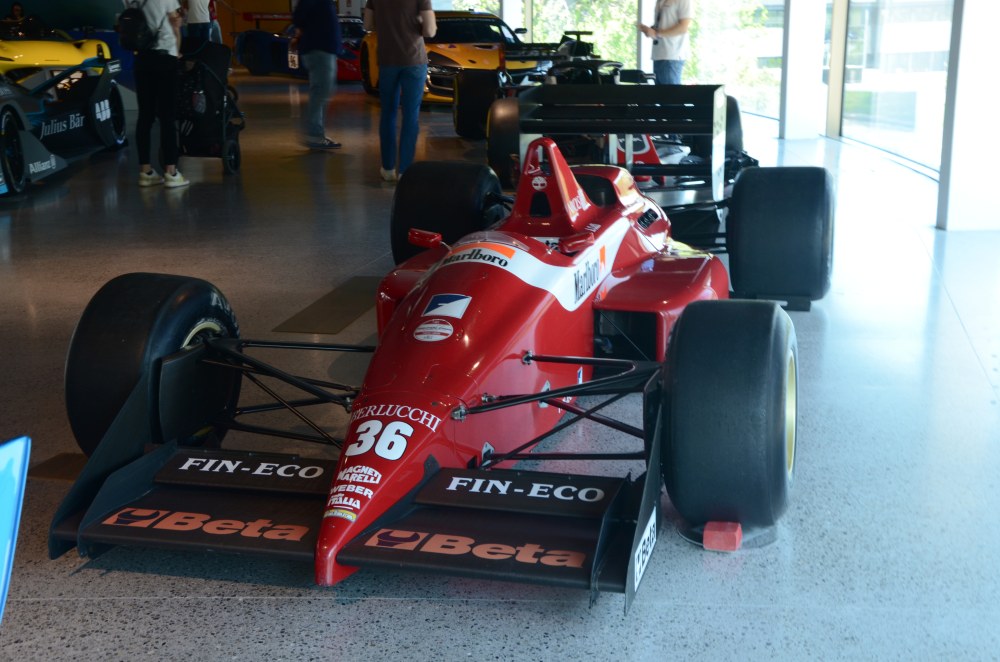
For 1993, Scuderia Italia ended its long association with Dallara and switched chassis supplier to Lola. The resulting Lola T93/30 retained Ferrari V12 power and was driven by Michele Alboreto and reigning Formula 3000 champion Luca Badoer. The change, however, proved unsuccessful. The T93/30 was significantly less competitive than its predecessors, and both drivers struggled throughout the season. Badoer's seventh place at the San Marino Grand Prix was the team's best result, and Scuderia Italia withdrew before the final two races of the championship.
At the end of 1993, Scuderia Italia joined forces with Minardi, another independent Italian Formula 1 team facing increasing financial pressure. The combined operation competed as Minardi in 1994, allowing the resources and backing associated with Scuderia Italia to remain involved in Formula 1, although the separate BMS Scuderia Italia entry had effectively come to an end.
Formula 1, however, represented only one chapter in the team's history. BMS Scuderia Italia subsequently concentrated on touring cars, sports prototypes and GT racing, disciplines in which it would achieve some of its greatest successes. The team returned to touring-car competition with Alfa Romeo before moving into international sports-car racing with the Ferrari 333 SP. This programme culminated in major success in the FIA Sportscar Championship, including both drivers' and teams' honours in 2001.
A new and particularly successful period began with the Prodrive-developed Ferrari 550 Maranello in the FIA GT Championship. BMS Scuderia Italia became one of the leading GT teams of the early 2000s, winning numerous races and securing consecutive teams' championships in 2003 and 2004. The programme also produced victory in the 24 Hours of Spa in 2004, followed by further success with the Ferrari 550 in the Le Mans Series in 2005.
The team later competed with Aston Martin DBR9 and DBRS9 machinery before returning to Ferrari with the 430 GTC. Its endurance-racing activities continued into the following years, including appearances at the 24 Hours of Le Mans and Spa. In 2010, competing as a Porsche-supported team, BMS Scuderia Italia finished third in the GT2 class at Le Mans and achieved an overall victory at the 24 Hours of Spa.
BMS Scuderia Italia therefore occupies an unusual place in racing history. In Formula 1 it was neither a conventional constructor nor merely a sponsor: it was an independent racing organisation that commissioned specialist manufacturers to provide its cars while retaining its own identity as entrant and team. Its partnerships with Dallara and later Lola produced a distinctive six-season Formula 1 programme, while its subsequent success in sports-car and GT racing demonstrated that the organisation's history extended far beyond its relatively brief Grand Prix career.
For Race Car Registry, this distinction is particularly relevant. Cars commonly referred to simply as “Scuderia Italia” Formula 1 cars were, depending on the season, constructed by Dallara or Lola and entered by BMS Scuderia Italia. The constructor, entrant and physical identity of the car are therefore related, but not interchangeable — precisely the type of distinction the registry is intended to preserve.
Scuderia Italia entered the Formula 1 World Championship in 1988. Rather than establishing a complete design and manufacturing department of its own, the team adopted an unusual but effective model: Scuderia Italia operated the racing team, while specialist manufacturers were contracted to design and build its cars. For its first five Formula 1 seasons, this role was entrusted to Dallara.
The partnership began in 1988 with the Dallara F188. Because the project was completed too late for the opening Brazilian Grand Prix, Scuderia Italia initially appeared with a modified Formula 3000 car before the purpose-built F188 made its debut. Over the following seasons, Dallara developed a succession of Formula 1 cars for the team, culminating in the Ferrari-powered F192 of 1992.
Scuderia Italia achieved its best Formula 1 results during its partnership with Dallara. Andrea de Cesaris finished third at the 1989 Canadian Grand Prix, giving the team its first podium, while JJ Lehto scored another third place at the 1991 San Marino Grand Prix. The team became a familiar part of the Formula 1 midfield during this period, competing with considerably larger and better-funded organisations while retaining the relatively compact structure of an independent entrant.
For 1993, Scuderia Italia ended its long association with Dallara and switched chassis supplier to Lola. The resulting Lola T93/30 retained Ferrari V12 power and was driven by Michele Alboreto and reigning Formula 3000 champion Luca Badoer. The change, however, proved unsuccessful. The T93/30 was significantly less competitive than its predecessors, and both drivers struggled throughout the season. Badoer's seventh place at the San Marino Grand Prix was the team's best result, and Scuderia Italia withdrew before the final two races of the championship.
At the end of 1993, Scuderia Italia joined forces with Minardi, another independent Italian Formula 1 team facing increasing financial pressure. The combined operation competed as Minardi in 1994, allowing the resources and backing associated with Scuderia Italia to remain involved in Formula 1, although the separate BMS Scuderia Italia entry had effectively come to an end.
Formula 1, however, represented only one chapter in the team's history. BMS Scuderia Italia subsequently concentrated on touring cars, sports prototypes and GT racing, disciplines in which it would achieve some of its greatest successes. The team returned to touring-car competition with Alfa Romeo before moving into international sports-car racing with the Ferrari 333 SP. This programme culminated in major success in the FIA Sportscar Championship, including both drivers' and teams' honours in 2001.
A new and particularly successful period began with the Prodrive-developed Ferrari 550 Maranello in the FIA GT Championship. BMS Scuderia Italia became one of the leading GT teams of the early 2000s, winning numerous races and securing consecutive teams' championships in 2003 and 2004. The programme also produced victory in the 24 Hours of Spa in 2004, followed by further success with the Ferrari 550 in the Le Mans Series in 2005.
The team later competed with Aston Martin DBR9 and DBRS9 machinery before returning to Ferrari with the 430 GTC. Its endurance-racing activities continued into the following years, including appearances at the 24 Hours of Le Mans and Spa. In 2010, competing as a Porsche-supported team, BMS Scuderia Italia finished third in the GT2 class at Le Mans and achieved an overall victory at the 24 Hours of Spa.
BMS Scuderia Italia therefore occupies an unusual place in racing history. In Formula 1 it was neither a conventional constructor nor merely a sponsor: it was an independent racing organisation that commissioned specialist manufacturers to provide its cars while retaining its own identity as entrant and team. Its partnerships with Dallara and later Lola produced a distinctive six-season Formula 1 programme, while its subsequent success in sports-car and GT racing demonstrated that the organisation's history extended far beyond its relatively brief Grand Prix career.
For Race Car Registry, this distinction is particularly relevant. Cars commonly referred to simply as “Scuderia Italia” Formula 1 cars were, depending on the season, constructed by Dallara or Lola and entered by BMS Scuderia Italia. The constructor, entrant and physical identity of the car are therefore related, but not interchangeable — precisely the type of distinction the registry is intended to preserve.
Organization history
Legal entities / company names
Historical legal organizations recorded behind this common team identity.
BMS Scuderia Italia S.r.l.
1983 –
present / open
Historical identity
Official / entry names
Historical official or sponsored entry names recorded for this common team identity.
Scuderia Italia
1988 –
1989
BMS Scuderia Italia
1990 –
1992
Lola BMS Scuderia Italia
1993 –
1993
Registry
Cars
3 vehicles currently associated with this team / entrant.